Political Cartoon Election of 1860 Speeding Car Clip Art
Political Cartoons Illustrating Progressivism and the Election of 1912
Background
The Progressive Era, as the period in history at the turn of the 20th century has come up to be known, was a time of tremendous social, economic, and political changes, and the presidential ballot of 1912 typified the reform spirit of the catamenia. Start in the late 1800s with the challenge to the "spoils system" of motorcar politics, progressivism gathered momentum between 1900 and 1916, as the want for reform permeated the minds of the American people. Reformers themselves were a various group, frequently with different views, but ever the same general purpose-- to reform America. Amidst them were politicians, labor leaders, religious leaders, and teachers, men and women who believed the federal government needed to address the ills of a modern industrialized society. Among their choices for president in 1912 were three major candidates, each of whom laid claim to successful reform measures.
The more famous reform leaders of the mean solar day reflected the diversity within the various reform groups. Robert Thou. La Follette, the senator and former governor of Wisconsin, and Theodore Roosevelt, the onetime governor of New York and president of the The states from 1901 to 1908, were members of the Republican Party. Woodrow Wilson, quondam governor of New Jersey and president from 1912 to 1920, was a member of the Democratic Political party. Each man had a history of challenging the status quo and enacting change while in office. Yet, they opposed each other during a entrada year that captivated the American people and challenged the two-party arrangement. In their opposition they brought to the forefront of American politics those issues that needed rapt attending, and they succeeded in addressing many of them, regardless of party affiliations.
As president from 1901 to 1908, Theodore Roosevelt believed information technology was his duty to define the major bug of the twenty-four hour period and to offering solutions. He believed the dominant consequence before the federal government was its relationship with large business. He pressed for government regulation of corporations and an cease to unfair pricing practices. He considered labor unions and farmers' cooperatives advantageous as a means of keeping the actions of big business organization in bank check. Roosevelt carried out 44 antitrust prosecutions, all the while assuring tense businessmen that he was only against enterprises which misused their size and economy of scale to discriminate against competitors and deceive consumers. Other important issues for which he attempted to garner support included a graduated income taxation and an inheritance taxation; initiative, referendum and think measures; direct primaries; and conservation.
Having stated in 1904 that he would serve no more than two terms, Roosevelt endorsed Senator William Howard Taft equally the Republican nominee in 1908. However, Taft proved more conservative than Roosevelt had anticipated, and eventually he regretted his endorsement. In Roosevelt's eyes, Taft had too frequently sided with the corporate giants and political bosses he had so relentlessly battled.
Taft was besides criticized by Senator La Follette who had vied with him for the Republican nomination in 1908. La Follette was arguably the most fervent reformer in the country with an impressive record of achievements in Wisconsin, amidst them pure food acts, child labor and compulsory instruction laws, and workmen's compensation insurance. His own larger reform platform, which eventually would be called the "Wisconsin idea," included the dictum of direct ballot of U. S. senators. As the highest profile Republican other than Theodore Roosevelt, La Follette believed himself to be the natural choice for the political party's nomination in 1912, and progressive Republicans supported him, including Roosevelt.
In Jan 1911 at La Follette's home in Wisconsin, a de facto Republican nominating committee reorganized as the National Progressive Republican League outlined their new platform, which called for 1) the straight election of U.S. senators, two) direct primaries, 3) the direct election of convention delegates, and 4) a constitutional subpoena for initiative, plebiscite, and call up at the federal level. If Roosevelt would not seek a third term, then La Follette was their obvious choice for leader. Notwithstanding, by late in that year, the members abandoned La Follette every bit their candidate when the immensely popular Roosevelt finally threw his hat back in the ring."Fighting Bob's" success had shown that the party was viable, but Roosevelt'south notoriety and national appeal made his chances of winning much greater.
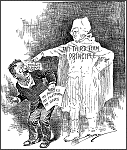
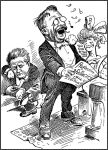
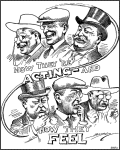
The showtime two featured documents, both political cartoons, satirize Roosevelt's reversal of his anti-tertiary term hope and his supposition of leadership of the Progressive Political party. Both La Follette and Roosevelt lost the Republican nomination to the incumbent, Taft, who still controlled the national convention delegates. Roosevelt, however, had swept 9 of the 12 states with primaries, including Taft'due south home state of Ohio. This primary boxing is characterized in the third featured document, a political cartoon picturing Ohio as the "Mother of Presidents." Victories in these primaries made Roosevelt and his progressives confident that they represented the will of the people. They officially appear their Progressive Political party and challenged Taft and the Democratic candidate, Woodrow Wilson. The fourth featured document, another political cartoon, displays the three candidates shortly before ballot twenty-four hours in 1912.
As opponents, Roosevelt and Wilson had nearly as much in mutual every bit they did in disharmonize. They both rejected the Republican's platform of status quo and opposed radical groups such as Eugene Deb's Socialist Political party of America. They both ran on records of political and economical reform, and they both supported stronger democratization of the political process. Yet Wilson, a Democrat, remained concerned for states' rights, disagreeing with Roosevelt'southward mandate for federal command of industry. Rather, he advocated more precise business organisation laws and prosecution for unfair business practices. He too called for a reduced tariff, something he associated with the protection of monopolies and special interests and the rise cost of living. Overall, Wilson was for limiting government power and was in stark opposition to such Roosevelt social welfare programs every bit workmen's compensation and the minimum wage.
The election of 1912 was the most memorable election of the Progressive Era and ane of the about unique of the 20th century. With reform-minded candidates every bit the top contenders, information technology was merely a affair of fourth dimension earlier the varied goals of the groups inside the Progressive Political party, from labor issues to conservation measures, would exist addressed through legislation. In fact, several of import constitutional issues were nigh resolution during the campaign year. The 16th and 17th Amendments to the Constitution were passed during Taft's administration and ratified early in Wilson'due south first term. Thus, Congress gained the ability to collect income taxes, and U. South. Senators would be elected by the people. In addition, women gained voting privileges when the 19th Amendment was ratified in 1920.
Resources
Aaseng, N. America's Third-party Presidential Candidates. Minneapolis, MN: The Oliver Press, Inc., 1995.
Blum, J. M. The Progressive Presidents. New York, NY: West. W. Norton & Company, 1980.
Peterson, A. The Election of 1912. Lakeside, CA: Interaction Publishers, 1992.
Understanding and Creating Political Cartoons. Madison, WI: Knowledge Unlimited, 1998.
The Documents
Anti-Third Term Principle
Click to Enlarge
National Archives and Records Assistants
Records of the United States Senate, Office of Senate Curator
Record Group 46
National Archives Identifier: 306175
Progressive Fallacies
Click to Enlarge
National Archives and Records Administration
Records of the Usa Senate, Part of Senate Curator
Record Group 46
National Athenaeum Identifier: 306096
Ohio, The Mother of Presidents

Click to Enlarge
National Archives and Records Administration
Records of the Us Senate, Office of Senate Curator
Tape Group 46
National Archives Identifier: 306104
How They're Acting and How They Experience
Click to Enlarge
National Athenaeum and Records Administration
Records of the United States Senate, Office of Senate Curator
Record Grouping 46
National Archives Identifier: 306083
0 Response to "Political Cartoon Election of 1860 Speeding Car Clip Art"
Enviar um comentário