Clockworks Weve Been Here Before and Well Be Here Again
Blitz: an epic interview with Geddy Lee and Alex Lifeson

On the eve of a U.s. tour that may be their terminal, Rush guitarist Alex Lifeson and bassist/vocalist Geddy Lee talk to Archetype Rock in a wide-ranging interview covering their unabridged career. They talk over their greatest piece of work – from their zinging, Zeppelin-influenced debut album through to epic masterpieces such as Xanadu and La Villa Strangiato and on to their 2012 concept album Clockwork Angels. They talk almost the complexities in drummer Neil Peart's lyrics, the obsessive nature of their fans, and the good times and the bad times in their long history together. They also address the question that all Rush fans in the Great britain want answered: will they ever play here again? Simply first nosotros accept them back to 1974 and that first album, Rush.
When yous think of the time when you made that record, what is the first affair that comes to mind?
Alex Lifeson: I think how exciting it was to be in the studio – even idea we could barely afford information technology.
Geddy Lee: It was a great time for us, and in that location's some corking raw stuff on that record. The beginning Rush anthology really stands upwardly ameliorate in some means than some of the later things.
That album was the only ane the band made with drummer John Rutsey, who left Blitz in 1974 and was replaced by Neil Peart. It's now vii years since John Rutsey died. How do you remember him?
Geddy: John was an odd gentleman. A hard person, in the sense that he had a hard time dealing with himself. He was not a happy guy, and had demons that he wrestled with. And when you lot're that kind of person information technology's hard for you to deal with other people. There was a lot of conflict and secrecy in the ring when John was in it. We couldn't really read him and he didn't really care to share that much with u.s.. And when Alex and I started pushing the music in a new direction, he eventually said: "I can't get behind this." That was the end.
Alex: John left before the album was released in the United States. But he was role of this matter. He had the same dreams that we had.
- Why did Coca-Cola object to having their advertizement appear on this Rush album comprehend?
- Rush: "We weren't defiant, we just figured 2112 was the terminal record we'd make"
- Q&A: Geddy Lee
- Ix Classic Rock quotes from Alex Lifeson
In those early on days, did you always believe that Rush would be successful?
Alex: I don't recollect we ever thought nosotros would be big. The dreams nosotros had then were of making more records and touring; playing in front of bigger audiences. We were playing high schools and bars. That was our world for half dozen years. As a Canadian band your chances of getting a record deal were slim, and getting out of Canada even slimmer.
Geddy: We were never that kind of obnoxious band that said: "Nosotros're gonna be huge!" We but hoped nosotros could be as good as bands we thought were good – Led Zeppelin and Deep Majestic and Yes and Genesis. When we toured with Kiss in 1975 we couldn't believe we were playing in America and travelling around. It was all and so new and exciting to u.s.a.. And nosotros honestly thought it was probably the last time this would ever happen to united states, so we should bask it. I call up I still have the keys to every hotel room from that tour. I kept them because I never idea I'd always be in Lubbock, Texas over again. And in fact I oasis't been to Lubbock, Texas again.
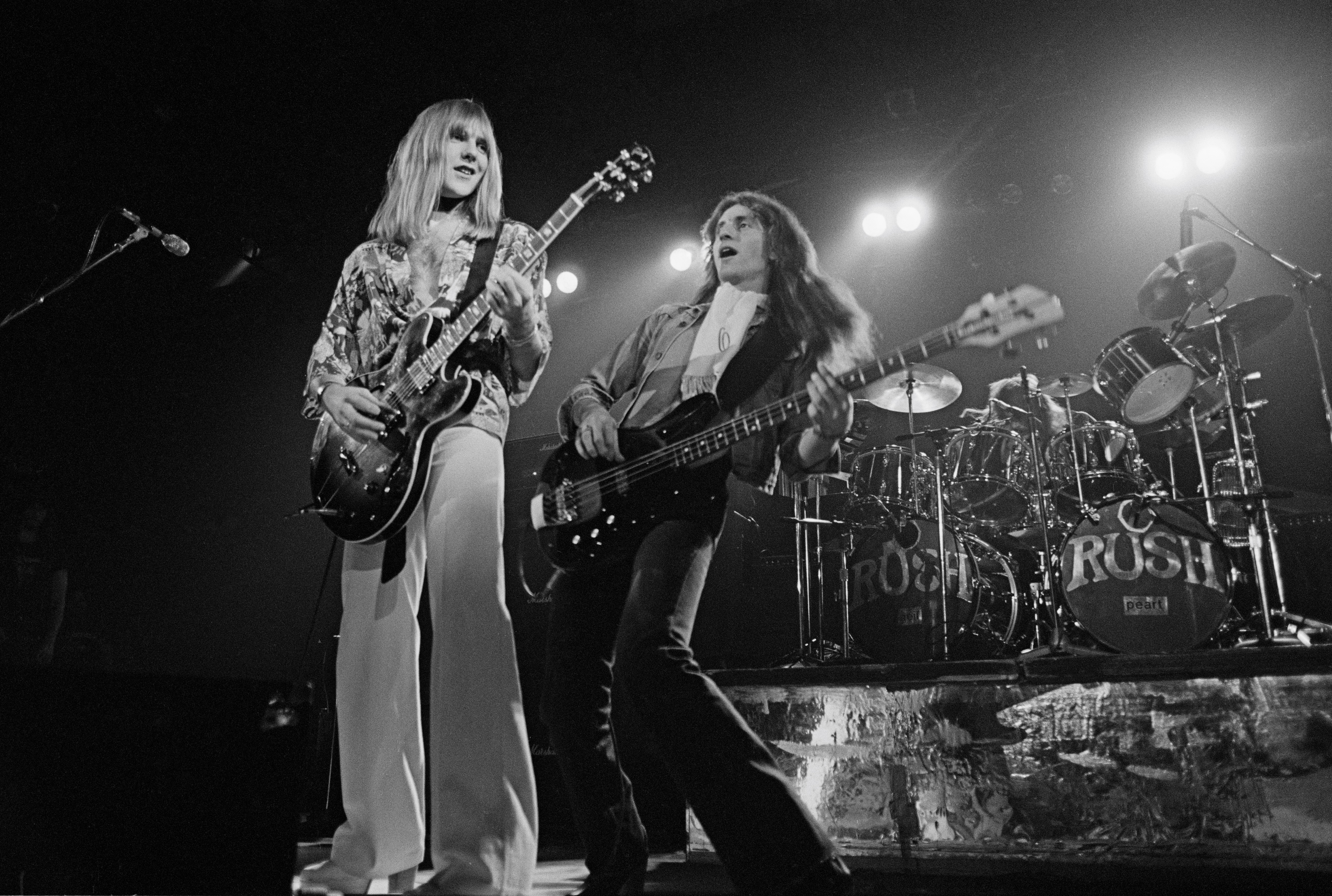
For all the success that you lot've had since then, were there times when you felt that – outside of your core fan base – nobody gave a shit most Rush?
Geddy: Oh, at that place were lots of times in our career when we felt it was such an uphill struggle. Many years ago, before we did 2112 [in 1976], nosotros idea we were going nowhere fast.
And later on?
Geddy: There were times when we didn't experience we were getting mass appeal, simply it wasn't something nosotros were looking for.
Alex: Nosotros've always been aware of the loyalty of our fan base. And information technology's shifted over the years, of form. In the eighties we lost some of the older fans from the seventies. And with all the stuff that's been happening in the past five or half dozen years in that location's been some other shift, with a whole new segment of younger fans plus all our older fans. At that place accept been points where there's been less involvement in full general. Merely nosotros connected to tour through those times and we've always done well touring.
The mid-nineties seemed to be a difficult time for Rush; the albums Counterparts and Examination For Repeat were widely ignored at a time when alternative rock had changed the musical landscape. Did you feel, deep down, that Rush had become irrelevant?
Alex: With every new era of music, whether it was punk or the whole Seattle scene in the nineties, information technology was supposed to accept carried a boom for our coffin. But we've ploughed through those times. Yes, there take been times when mayhap in a broader sense nosotros seemed irrelevant. But nosotros've always managed to keep. And really, nosotros never cared whether we were relevant or non.
Blitz are a progressive rock band in the broadest sense; the music has constantly adult across the years.
Geddy: I call up that'due south true. In a mode, nosotros've always been searching for a new u.s.. That'due south been our curse and our approving – we always recollect there'south a better version of us to be done on the next record.
Alex: I don't call back all our records are completely successful, from a creative standpoint. But we e'er tried with each record to practice exactly what we wanted to practise.
Geddy: And actually, any criticism nosotros've had was off-white game for the time [laughs]. When you've been a band as long equally we accept, and been through the ups and downs we've been through, you take everything in its footstep. We've made a lot of mistakes on tape, but we've been able to learn from them and move forward. We've aged well considering we've been able to apply the things we've learned. It'southward all part of evolution.
What are those mistakes y'all've made on record?
Geddy: I don't know if unabridged albums autumn into that category, but certainly there are songs that I don't experience great most.
For example?
Geddy: Just recently I listened to the song Neurotica [from 1991's Roll The Bones) and I thought, what the fuck was that? Information technology'due south just a foreign tune. I feel we've had a very up-and-down career every bit songwriters, but one thing that's always held true is our honesty virtually what we're doing. Similar it or not, this is what we are [laughs].
Certainly you're renowned as a grouping of virtuoso musicians. And if in that location is one Blitz vocal, to a higher place all others, that captures you all playing at the top of your game, information technology has to exist the classic La Villa Strangiato, the ix-infinitesimal instrumental tour de force from 1978's Hemispheres.
Alex: Information technology admittedly is. It'south epic. There are so many parts to that song, and everybody shines on information technology. My recollection is that it was only a few takes to record the song. In fact if yous mind closely during the guitar solo you tin hear the previous solo ghosting underneath. I recollect us playing the whole song in 1 piece and so we dropped in for that solo.
There's some other epic – Xanadu, from the previous album, A Farewell To Kings – that you besides recorded in ane accept.
Alex: With Xanadu, we ran that down one time to go the sound and levels, and then we hitting 'tape' and played the song and information technology was done. Pat Moran, the engineer on that tape, was shocked. Seldom did a rock band practise i have of a song that's 11 minutes long. He was blown away.
It was afterwards those landmark albums of the late seventies that the modern Rush was built-in, with songs that were shorter and more direct. And from Neil Peart there was a new approach to lyrics, in which he ditched the fantasy and sci-fi themes of 2112, A Farewell To Kings and Hemispheres.
Alex: We just felt we were working to a formula that was a picayune stale. Hemispheres was really a difficult record to make. It was written in a cardinal that was very difficult for Geddy to sing, in a actually high annals, the whole tape. Information technology was time to move on.
Geddy: For some of our fans, records similar Hemispheres, that'south their favourite Blitz. And when we started changing and our songs got shorter and more tuneful we lost those fans.
The 1980 album Permanent Waves was really the bridge between the old Rush and the new Blitz, the link between Hemispheres and the modern rock of 1981'south Moving Pictures.
Geddy: Permanent Waves actually is kind of a bridge album, and a hugely important record for the states.
Alex: I don't know what it is about the chemical science betwixt us, but I call back without Hemispheres we wouldn't have gone to Permanent Waves the mode nosotros did. Permanent Waves was really a hybrid of Hemispheres and Moving Pictures. Nosotros all the same had some long tracks on in that location – Jacob's Ladder and Natural Scientific discipline – just as well shorter songs like The Spirit Of Radio and Free Will.
Which practise y'all recollect is the unsung classic in the Rush catalogue? For some fans it's the 1984 album Grace Under Pressure.
Alex: Grace Under Pressure level is a practiced choice. Signals is a flake like that also – overlooked because it came after Moving Pictures. Looking dorsum, I think Grace Under Pressure suffered in production, only the songs are really strong and in that location's neat diversity on that record. Counterparts is another one. There'southward a lot that I really like about that record. There'due south a feel most it, a tone and a mood.
Geddy: When we were doing Grace Under Pressure it was a pretty low fourth dimension for united states. Nosotros weren't sure of the kind of ring nosotros wanted to be. There was a lot of experimenting. And in that location was rejection from different producers that we'd hoped to piece of work with – that was a bit of a reality sandwich nosotros had to swallow [laughs]. We ended up pretty much producing that record on our ain, and it was hard.
On the albums that followed Grace Under Pressure – Power Windows in in lxxx-5 and Concur Your Burn down in eighty-seven – the ring'south sound became increasingly dominated by Geddy's use of synthesisers. How do you feel about those albums now?
Geddy: Those records were also experimental. Ability Windows was a loftier note. That was a great tape. Some of the piece of work we did on Hold Your Fire was very positive, some of it less successful. And then in that location were a lot of ups and downs in those years. But the cumulative body of piece of work, the best from those years, stands up pretty well.
Alex, you've said in the by that you felt marginalised in thas period, your role equally guitarist limited. Yous said you were frustrated. Were you also depressed?
Alex: Honestly, no. I've been fortunate that way. I've been downward at times, yeah, because I've felt trapped or bored. But depressed? Non really. It'due south not in my nature.
Geddy: It was a difficult time for us. Alex was resistant, of course, because more and more than keyboards were coming into the band.
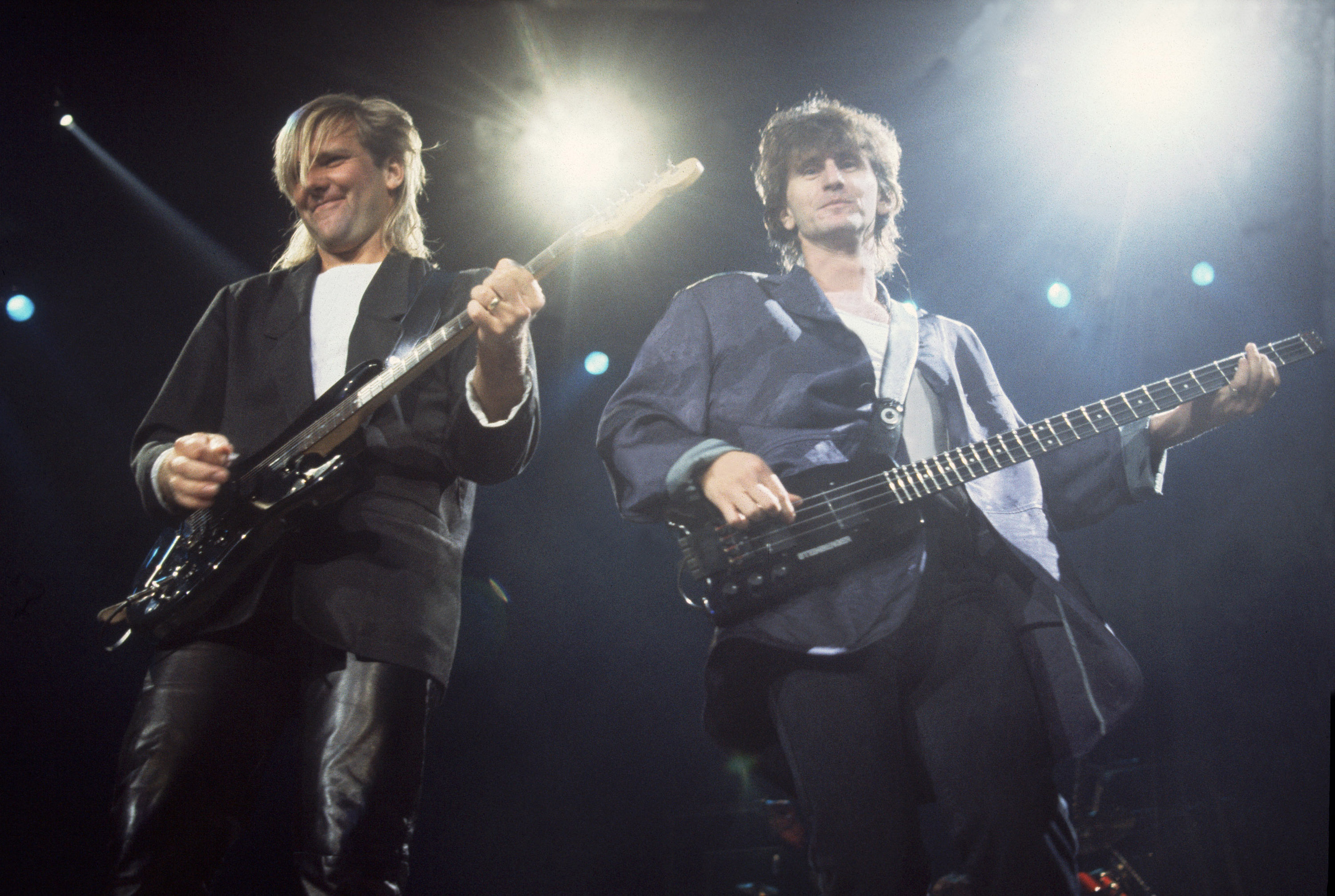
Did that pb to arguments between you?
Geddy: I call up information technology'due south more than in our nature to quietly harbour resentments than to continue attack mode. Only nosotros had some pretty assuming conversations, I'd say. All the cards were on the table.
Toto guitarist Steve Lukather says that his band used to fight over music. Did that happen with you?
Alex: I can't say nosotros ever did. In that location was never a personal effect. If we had a disagreement over something, whether it was musical or otherwise, we always talked it out.
Is Blitz is a genuine working democracy?
Alex: It always has been. And it wasn't just a majority that ruled, information technology had to be unanimous in whatsoever determination. And then if two guys wanted to do something and one didn't, and so yous talked nigh it, you worked out the pros and cons, and at the end of it, if there was still that one that didn't want to do it, it didn't become done. Information technology wasn't worth having the bitterness over some seemingly meaningless conclusion.
Is Neil as open to discussion about the lyrics he writes?
Geddy: I am a fan of Neil's, and I love being a collaborator with him, considering he is and then objective and like shooting fish in a barrel to piece of work with. We'll exist recording songs, and stumbling over a word or something, and if Neil is not in the studio we'll get him on the phone and talk over it. He'll fifty-fifty allow me to suggest lyrics – a word that might work well – and he'll have it or he'll come up with a better 1. He'due south really a pleasure to work with. With Neil there are no hissy fits, ever. And also, over the years he'southward go more and more sensitive about shaping the lyrics to brand my job as a singer easier. He looks back at some of his lyrics from the past, the things he'southward given me to sing, and he doesn't know how I did information technology [laughs].
Alex: When information technology comes to lyrics, Geddy is very gratuitous with the scalpel. He does severe editing, because he wants to exist able to know clearly what the idea of a song is. Ged's got a great sense of what the presentation of those lyrics needs to exist for everyone to have an agreement of what's going on. Ged's got this way of dent it downwards to its essence. And it makes the delivery more convincing for him, and that's what he's all about. And Neil's really skilful about that.
Geddy: Yous focus on what works, not what doesn't piece of work. And if it was ever something that meant a lot to him, we'd have to discuss it conceptually: why is it not working for me?
Have there been times when Neil has written a lyric that you don't understand?
Alex: His lyrics are not easy. A lot of times I have no idea what he's talking about [laughs].
A lot of people were baffled by the story Neil wrote for the Blitz's 2012 concept album Clockwork Angels. Did you lot go information technology?
Alex: Oh, with Clockwork Angels I was probably more confused than always.
Geddy: I understand it quite fine. I spent months working on those lyrics and discussing them with Neil. We went back and forth with some aspects of Clockwork Angels quite a lot, to make certain that it came off more universal and less overtly proggy.
Alex: Neil is so patient with that sort of thing. If I'd written a song and it was existence dissected the fashion his lyrics are dissected, and then rewritten and rewritten, I don't call up I could practise it. Specially with x or eleven songs on the record. I think I'd have strangled Ged. And then strangled myself.
If you were to selection one song to illustrate how great a lyricist Neil is, which would it exist?
Geddy: I love Blowing, from the Roll The Bones album. That's a song in which very petty was changed in the lyrics from its original inception to the final version.
Alex: I recollect The Pass is really beautiful. That was i of those songs that happened very quickly. Resist is another i. I dear the lyrics in that song, they really speak.
Every bit a Blitz nerd of 30-5 years' standing, I'd say that this ring, more any other, brings out the geek in its fans.
Geddy: I think at that place's truth in that, for sure [laughs].
Do you understand why?
Alex: Maybe because we take it more seriously in one mode. Maybe our music, and the lyrics, are geeky?
Possibly it'southward the detail in your work. There's so much of information technology to obsess over.
Geddy: The fans love detail. As we do. We put a lot of detail into our music and our album covers and the movie and our alive show. We try to have a lot of stuff to keep people amused and entertained.
Alex: There is certainly a lot of particular to obsess over [laughs]. It's non just shallow music to make you feel good, that'southward for sure! It'southward serious music. And I guess we've been doing information technology for so long, that is the characterization we've earned.
Rush are likewise, for many fans, a lifetime obsession – once yous're in, there's no getting out again.
Geddy: Ha ha. Yes, that's also very true.
Some fans – myself included – similar to savour the moment whenever a clock ticks over to 21:12. The last time I did this, holding up my telephone to show my wife equally I declared: "It's Blitz o'clock!", she rolled her eyes.
Alex: I recollect your wife and my wife would go forth really well [laughs].
Have you lot ever done that?
Geddy: I haven't. But mayhap if I'm in an airport at that time of the evening and I run into a digital clock…
You let yourself a fiddling grinning?
Geddy: Yes, I do.
It'due south this level of geekiness in the fans that was so well-portrayed in that famous scene from the picture I Beloved Yous, Man, when ii buddies are at a Blitz prove, watching yous play the song Limelight, and singing every give-and-take to each other. Information technology'southward all rather embarrassing, and nosotros've all done information technology.
Geddy: Well, that picture show definitely hitting upon that affair of going to a prove and letting become and enjoying the moment. And I think that's an of import affair to think when you love rock music: that in that location is a sort of freedom in allowing yourself that sense of abandon, and digging your band. From the outside looking in it can be embarrassing, for certain.
With such a loyal fan base, Rush are the biggest cult ring in the world. Is that, for you, the perfect scenario?
Geddy: Pretty much, yep. In that location'south nothing wrong with that.
Alex: For united states, having that cult status for so long was a real safety net. You could be sort of famous, really well-known to a pocket-size pocket of people, and carry on an beingness that was perfectly normal. In that location is a degree of discomfort that comes with being famous, merely it'due south office of the chore. And, hey, there are worse issues.
Geddy: I think for many years people didn't know much near the states, and we were never crazy about doing a lot of printing. But equally time has gone on nosotros've grown more comfy with ourselves, more comfortable in our role equally a band and more comfortable around people, and I think that has contributed to our appeal. When people see this band, how we've stuck together and remained friends for all this time, I think that makes people feel skillful about the possibility of long-term relationships [laughs].
Alex: And despite the success and the fame that comes with it, I think you can residuum it. With fame you can't just shut information technology off and be a dick. You have to be at least a lilliputian fleck open up and gracious. I call up you have to requite some time to people that support you, who intendance nearly what y'all're doing and are moved by it. Information technology'southward a affair of courtesy. I was raised by my parents to be very courteous. It's in me, and I'd experience badly if I brushed somebody off or was rude to somebody.
You've talked about this band being in its terminal stages. When information technology'due south finally all over, will you stay agile in music?
Geddy: Most definitely. It's in my nature to be productive. I like to be active. So music volition always exist something I promise to exercise in any context it is. Also, musicians and artists don't retire. You lot either work or you stop working. When people talk nigh retirement it infers punching the clock, and I don't like to look at my life like that.
Alex: The thought of retiring – sitting on a embankment in Florida, that sense of retirement – is non what I would do. I would travel. And I would be as active as I could be. I get these offers to play on people's records, do some production, and I would pursue that even more. I beloved writing. I'm always writing music when I'm domicile. And I always want to play guitar as long as I can.
Clockwork Angels was such a big success. It was number one in Canada, number two in the US, and was widely acclaimed every bit i of the best albums Rush accept ever made.
Alex: I felt similar we'd actually accomplished something with Clockwork Angels – a record that did actually well at this late stage of our career.
Geddy: I wanted to tour that album forever. I had then much fun on that tour.
Are you lot already thinking about another album?
Alex: Geddy and I have talked nearly getting together on our next fourth dimension off and but writing for the fun of information technology. Neil loves recording and always has.
Geddy: But to exercise another record, information technology has to have that one hundred per cent commitment from all of us. I don't remember you can become into a Rush record, or any Rush project, half-assed. You lot've got to really want to do information technology.
So…
Geddy: The conversation nigh time to come albums has to await until after this current bout. But in that location is no negativity about it.
You've said there volition be no large tours for Rush in the future. Could you envisage making an album simply non touring with information technology?
Geddy: I tin see us making a record and playing live but not playing a lot of shows. I can see us doing a record but not doing a tour.
Alex: I could see us doing two or 3 weeks of dates. A few years back I saw David Gilmour, the On An Island tour. I think he did eighteen dates on that tour. He was out for a few weeks, and that was it. When I saw that show, oh my God, information technology was so astonishing. He was playing then well. And what a fantastic presentation! And he probably put the same corporeality of piece of work into doing those iii weeks that we would put into doing ten months. And that's kind of cool, that yous would commit that amount of energy and work to do just a few dates and that's it. I can see u.s. doing something similar that.
Tickets for your electric current United states of america tour take sold very fast.
Alex: They have. I think peradventure a lot of Rush fans are anticipating that this may be the last major tour that we do, and they want to get their terminal dose in [laughs].
Led Zeppelin were such a huge influence on Blitz in your early days. Can you understand why Robert Plant refuses to exercise a Zeppelin reunion tour? Information technology'southward a frustrating state of affairs for Jimmy Page.
Geddy: I can meet that. I understand how Jimmy Page feels. He still wants to do it, and Robert has moved on. But Robert is no less busy, he'south only decorated with fresh things, he needs new stimulus. And I have total respect for that.
Do yous besides feel, as a vocalizer of a certain historic period, that Establish has the most to lose if Zeppelin re-formed?
Geddy: Yeah. Information technology'due south harder for the vocalist, in many ways. When the singer ages in front of the public, they tin hear information technology. To be the vocalist in Led Zeppelin, it's a fucking tough job. It takes a lot of field of study and a lot of piece of work. And then I understand his reluctance to want to do that again, whereas he is very creatively fulfilled with all these various projects that he does. Skilful on him. I'm happy for him.
You've done a lot of rehearsals for this US tour. Do you lot really need to?
Alex: Oh yes. I started in January, playing more regularly. Through March I was at my studio iv or five days a week for three or iv hours of solid playing. Neil and Ged did the same thing a month before rehearsals. We rehearse for the rehearsals!
Why?
Alex: We like to be so prepared for that first show that we feel similar information technology's our twentieth show. It pays off. That get-go nighttime, you feel confident. That's the way we've ever done information technology.
So what is in the gear up-list for this tour?
Alex: We've dug deep. Nosotros've pulled out some songs that we haven't played in a very long fourth dimension. We've pulled out some real fan favourites. And we're enjoying playing them. We've revisited every era except perhaps the mid-eighties era, which we covered in a adept portion of the attack the last bout. We've non included annihilation from Power Windows or Concur Your Fire, only in that location's something from only about every other record.
Tin can you exist more specific?
Alex: We're bringing the Hemispheres Prelude and Jacob's Ladder and Cygnus X-one. It'due south fun and exciting to play these old songs. Jacob's Ladder sounds amazing! For years we've discounted it, although information technology was always a fans' favourite. We've got 3 sets – A, B, C – which we'll be rotating throughout the tour.
Geddy: It's funny, some of those onetime songs sound so strange to me now, but when you beginning playing them you get back into that head-infinite y'all were in when they were written and recorded.
You autumn in love with those songs again?
Geddy: It's really all most your sense of perspective. A few years ago we brought back The Camera Eye [from Moving Pictures]. I never wanted to play that song. I never idea it was peculiarly worthy. And yet it was 1 the most requested Rush songs. I couldn't empathise it. How could people be then incorrect?
So what changed?
Geddy: I realised I underestimate the moment in time – the context of that moment. When nosotros started playing The Camera Centre, I thought, okay, at that place are a lot of pretentious moments in this song. It hasn't aged well. Simply then I started re-learning the keyboard parts and putting together a slightly different version – instead of xi minutes it clocks in at nine-and-a-half. And in the playing of information technology, aye, I cruel in love with it again. And that'due south where it becomes very subjective, and not objective. I stopped being able to tell if information technology was a pretentious song, and I just enjoyed playing those chords and I remembered why the vocal got recorded in the first place – I liked the chord progression and the song melodies. Yous tin get back to that time and capeesh what you lot were trying to do. This vocal – information technology was a indicate in your life, and fans want to relive that point in your life and y'all can take fun playing information technology. I dig the hell out of that song at present.
What else is planned for the tour?
Alex: Ged and I have gone crazy on bringing out all of our onetime instruments and buying up vintage gear all over the place. His goal is to play a dissimilar bass for every song in the show.
And for Rush fans in the UK, the large question is very unproblematic: will y'all coming back?
Geddy: I'm e'er coming back. I spend a lot of fourth dimension in London. I take a place there. It's i of my favourite towns on globe.
You lot know what I hateful – your fans in the UK want to see the band play alive again.
Geddy: At that place's nothing on the cards right at present. I would say that there are those of us that would prefer to do some dates in the U.k. and even some European dates, and there's an opportunity, once we get rolling, to run across what we might want to add. But let'south just say that at this signal that Neil's made it clear that he's skilful with this Usa tour being the last group of dates.
Alex: Y'all never know. These past couple of months have been pivotal. It'south shown us, later on a year and a one-half off, how much nosotros really love doing what we're doing. I call up that'southward really important in Neil's instance. Just when you've only got and then much time to play with it'south tough.
So y'all're letting the states down gently?
Alex: Well, like I said, you never know what will happen. Simply I'll say i matter: Geddy feels it's important that nosotros go back at this time to the Great britain, to acknowledge the back up you've given us for all these years. And I agree with him.
So what changed?
Geddy: I realised I underestimate the moment in time – the context of that moment. When nosotros started playing The Camera Center, I idea, okay, in that location are a lot of pretentious moments in this song. It hasn't aged well. But then I started re-learning the keyboard parts and putting together a slightly different version – instead of xi minutes it clocks in at nine-and-a-half. And in the playing of it, yep, I savage in honey with it again. And that's where it becomes very subjective, and not objective. I stopped being able to tell if information technology was a pretentious vocal, and I just enjoyed playing those chords and I remembered why the song got recorded in the first identify – I liked the chord progression and the vocal melodies. Y'all tin go back to that time and capeesh what you lot were trying to do. This vocal – it was a indicate in your life, and fans want to relive that point in your life and you can accept fun playing it. I dig the hell out of that song now.
What else is planned for the tour?
Alex: Ged and I have gone crazy on bringing out all of our old instruments and buying upward vintage gear all over the place. His goal is to play a dissimilar bass for every song in the show.
And for Rush fans in the Uk, the big question is very simple: will you coming back?
Geddy: I'm always coming dorsum. I spend a lot of time in London. I take a place in that location. Information technology'southward one of my favourite towns on earth.
Yous know what I mean – your fans in the United kingdom of great britain and northern ireland desire to see the band play live again.
Geddy: There'southward nothing on the cards right at present. I would say that there are those of us that would prefer to do some dates in the UK and even some European dates, and in that location's an opportunity, once we get rolling, to see what we might want to add. But let's just say that at this betoken that Neil'due south fabricated it clear that he's good with this United states of america tour being the last group of dates.
Alex: You never know. These past couple of months accept been pivotal. It's shown us, later a year and a half off, how much we really love doing what nosotros're doing. I think that's really important in Neil's case. But when you lot've only got so much fourth dimension to play with it'southward tough.
And so you lot're letting us down gently?
Alex: Well, like I said, you never know what volition happen. But I'll say one thing: Geddy feels it'southward important that we go back at this time to the United kingdom, to acknowledge the support y'all've given us for all these years. And I concur with him.
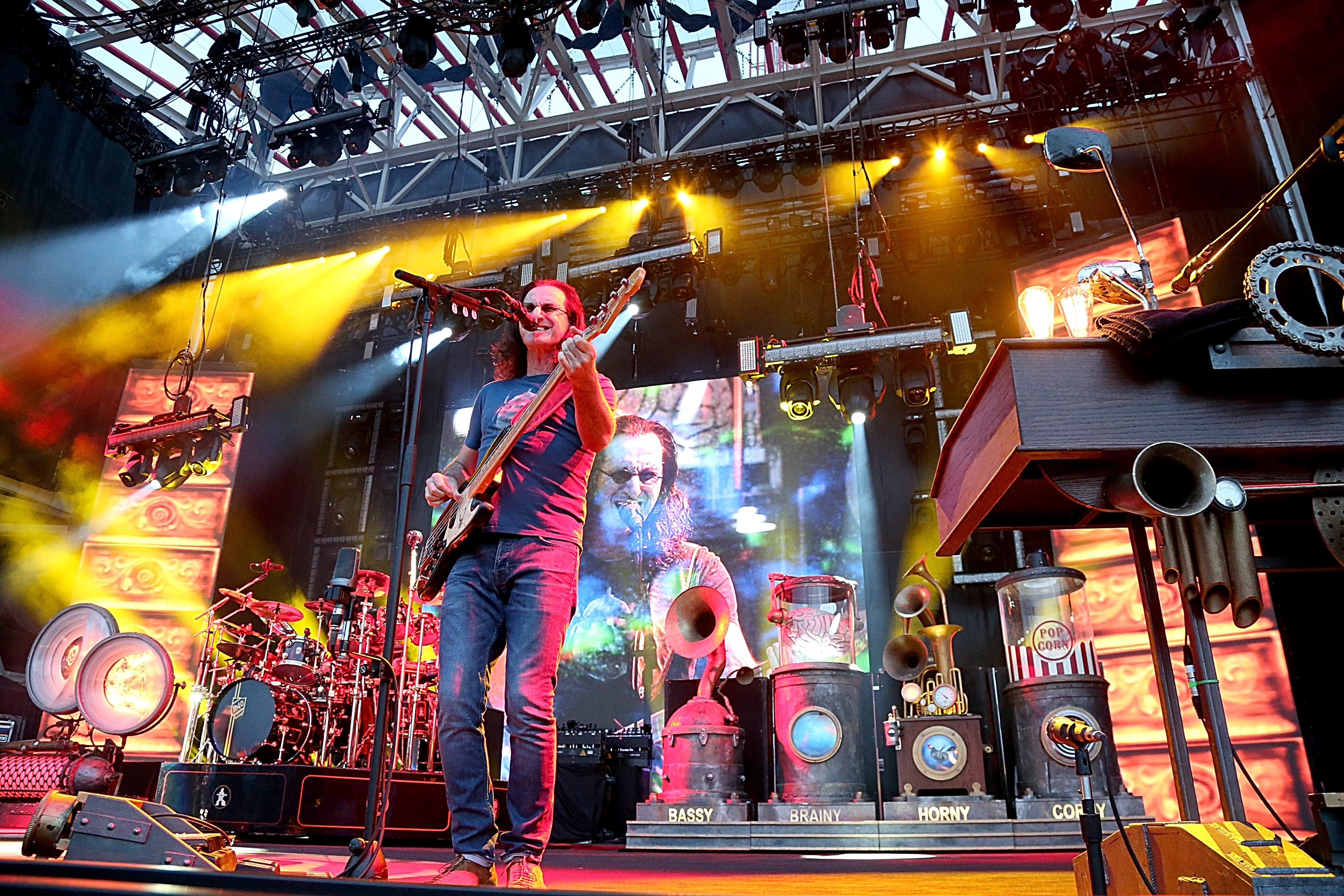
Blitz: "Nosotros're coming towards the terminate"
Source: https://www.loudersound.com/features/teamrock-exclusive-rush-q-a-the-bonus-bits
0 Response to "Clockworks Weve Been Here Before and Well Be Here Again"
Enviar um comentário